Google
WWW avastu.com
ashishanand85.blogspot.com
ashishanand85.googlepages.com
Showing posts with label Open Source. Show all posts

Sunday, March 25, 2007

No open source future for Virtualization?

Industry experts take Dana Blankenhorn on as he believes that there is no open source future for Virtualization. Tarry Singh, CEO Avastu Appliances, says:

I don't get it. Is it taking a jab at all other firms like Redhat, Novell, Virtual Iron and warning them not to rely too much on Xen? This summary is rather succinct and honestly does not do any justice to what the Open Source is capable of.

Alex Weeks, author of the Linux System Administrator’s Guide, says :
Like Tarry, I don’t get Dana’s point. In fact, I’m not even sure why ZDnet published this. It really lacks any point. I think he’s trying to make a point without really understanding the technology. Or any technology for that matter. I read some of his other articles, and he doesn’t seem to get any where. It’s like he’s writing inside jokes that only he understands. In his articles, he starts to go somewhere but never goes there.


Indeed open source is important to our future and virtualization is the next big thing. Combine the two and what you get is a deadly mix!

Friday, March 23, 2007

Virtualization & Open Source in India

The Indian IT market is estimated to touch $65 billion by 2009, posting a compound annual growth rate of 21 percent. The market, on the back of strong demand over the past few years, has emerged as the fastest-growing one in the Asia Pacific region.IDC India Limited, an IT industry analyst firm, has predicted that the year 2007 will witness Indian enterprises graduate to the second level of Dynamic IT infrastructure – where IT infrastructure can effect changes fast in response to the changing business scenario. The key technology components to attain this state are virtualization, SOA and application integration. CIO India examines the impact of open source & virtualization.


.......What has caused the effective price of virtualization to head toward zero -- and how? In contrast to many who seem to feel that open source and proprietary software operate in two parallel but separate universes — that open source is used by people who can’t afford ‘real’ software, while proprietary commercial software is for organizations that need reliability, scalability, and all the other ‘abilities’ — I believe that open source is already challenging the proprietary software world.

How about a case study to test the theory? Let’s look at virtualization, something that has tremendous potential with a clear payoff: reduced costs for IT organizations, both hard (power, machines) and soft (admin and operations personnel). It evinces an undeniable fact: machines are improving so fast that they make possible a change to the traditional hardware infrastructure, breaking the bounds of the one machine, one application practice used by most IT shops....

Read on.


Thursday, March 8, 2007

openQRM Virtual Appliance: Manage your Linux, Unix, Windows Virtual & Physical DataCenter!


The Avastu Team with close cooperation with the openQRM Team, has released the Virtual Appliance.

Get it on the VMTN Appliance Market Place:

NOTE 1: To download the appliances please send an email to: info[at]avastu.com

NOTE 2: For requesting downloads @Avastu please do NOT use free email addresses such as hotmail.com, yahoo.com etc.

This is a "Complete Datacenter Management & Provisioning software" with


  • File system images of Fedora Core 5 AND Centos 4

  • Two diskless nodes

We can customize the product and help you deploy it in your test, development labs and even production! (We are already assisting our current client with several openQRM installations in production).


Details for Testers/Developers/Administrators:


  • user = root

  • password = sysadmin

  • File System Images: Fedora Core 5, Centos 4

  • Nodes : 2 (two) diskless nodes

  • IP address for url: 192.168.1.100

  • WebAdmin username= qrm

  • WebAdmin password = qrm


What can openQRM do?


Data center needs and problems


Growing number of commodity servers leads to:


* Increasing number of failures – furthering downtime.


* Servers managed individually lead to:


  • greater opportunity for operator error

  • inconsistent imaging and policies applied across servers

  • over-provisioned or peak-provisioned systems

* Growing management costs – hardware and software are a small part of the price.


Bottom line: System administrators spend a significant amount of time either fighting fires or repeating multiple steps to manage a growing number of individual Linux boxes. Ultimately, the x86 data center is not always reliable, does not meet business needs, and creates inefficiencies in terms of administrative costs per server.


The Solution


Open Resource Manager addresses the needs of the modern data center by:


  • Improving reliability on the hardware and application level

  • Giving system administrators full control of the data-center

  • Provisioning servers within a few minutes

  • Consistently applying policies across servers

  • Adjusting resources based on business demands

  • Managing heterogeneous x86 hardware

Read More at openQRM site


Enjoy your virtual appliance!

Wednesday, March 7, 2007

Do You Ubuntu?


Ubuntu is "the belief in a universal bond of sharing that connects all humanity." Some say Ubuntu means 'I am what I am because of what we all are' (Tarry's tagline "extended" :p). Don't worry guys, I am not thinking of becoming a poet - at least not in the near future ;-)
Well, Ubuntu is a free, open source Linux-based operating system. The choice of Ubuntu as the name for this OS reflects a deep appreciation for the supportive, cooperative collaboration that is the basis of the Open Source Software movement, the global nature of the participants in the Ubuntu project, and the rich, helpful community that is growing up around the Ubuntu distribution.

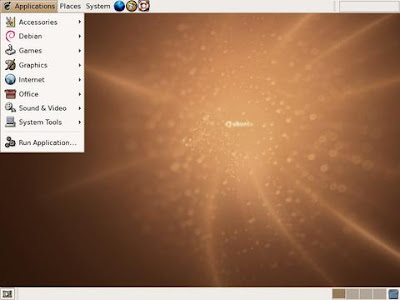
Ubuntu's DESKTOP

Ubuntu has a pretty desktop at startup. The Gnome taskbar is quite user-friendly. Look at the screenshot and speculate for yourself.


NAUTILUS (File Manager)

Nautilus is Ubuntu's file manager. It works in two modes - the browser mode and the simple mode. The simple mode is stripped down and is probably the fastest file manager in Linux. But the simple mode isn’t advisable for someone who is extremely familiar with windows. The sidebar isn’t limited to showing the folder tree only. It can be used to show information about the folder and the selected items.


OPEN OFFICE

Open Office is similar to MS Office. There are many added advantages too, like the built in Export to pdf tool. It includes the key desktop applications, such as a word processor, spreadsheet, presentation manager, and drawing program, with a user interface and feature set similar to other office suites.

BROWSERS

The default browser is Firefox. You can also download and use other Gnome browsers like Galeon or Epiphany.


RHYTHMBOX

Rhythmbox is the default music player for Ubuntu. It does not look cool at all and has a dull interface. And it's nothing more than ordinary when compared to other media players such as the windows mp, the iTunes, winamp etc.


Ubuntu has fuelled the ongoing debate between the open source advocates and proprietary software makers & users. Can Linux offer a viable alternative to Microsoft Windows?
It can! Try it to believe it.


PS: Ian Murdock, the “ian” in “Debian”, founder of the Debian distribution uses Ubuntu on his desktop!


Google
WWW avastu.com
ashishanand85.blogspot.com
ashishanand85.googlepages.com